Praggnanandhaa vs Magnus Carlsen: How India’s rising chess star eclipsed World No.1 twice in a week at Las Vegas Freestyle event
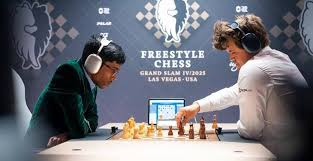
In a dramatic and historic display of talent, 19-year-old Indian Grandmaster Rameshbabu Praggnanandhaa achieved what many in the chess world only dream of—defeating reigning World No.1 Magnus Carlsen twice in the same week. The setting was the innovative and unpredictable Las Vegas Freestyle Chess Grand Slam Tour, a stage designed to reward creative brilliance and strategic depth. For Praggnanandhaa, it turned into a career-defining breakthrough.
What is Freestyle Chess?
Unlike classical formats that follow the well-established rules of chess openings, Freestyle Chess (or Chess960) randomizes the initial position of the pieces, leveling the playing field and testing pure chess acumen. This format neutralizes the deep opening preparation of elite players like Carlsen and allows fresh, imaginative minds to thrive. And thrive Praggnanandhaa did.
The First Encounter: Tactical Precision Over Power
The first face-off occurred on July 17, in the group stage of the tournament. Praggnanandhaa had White pieces in a 10+10 rapid format. From the outset, he played confidently, showing no signs of intimidation in front of the former world champion. The middle game saw Carlsen make a subtle error in pawn structure, which Pragg—known for his deep positional understanding—exploited with clinical efficiency.
In just 39 moves, the Indian teenager secured a stunning victory. Analysts pointed out his knight maneuver to f5 as a masterstroke, disrupting Carlsen’s coordination and seizing control of the game. The win not only caught the attention of the global chess community but also knocked Carlsen out of contention for the tournament title.
The Second Win: A Statement, Not a Fluke
Three days later, on July 20, Praggnanandhaa proved his earlier victory was no accident. In a semi-final classification match, he once again dismantled Carlsen’s position with ease and calm. This time playing with Black, he stayed solid through the opening and transitioned into the endgame with three connected central pawns, charging forward. By move 43, Carlsen was forced to resign, his pieces unable to counter the advancing force.
It was not just a win—it was a reaffirmation of Pragg’s elite status. Defeating Carlsen once is rare. Doing it twice in a week in different games and with different colors? That’s the mark of a future world champion.
Reactions from the Chess World
The chess community erupted in excitement. Social media buzzed with praise. Former players, commentators, and fans hailed Praggnanandhaa’s victories as a changing of the guard moment. Even Carlsen, known for his poker-faced demeanor, acknowledged the rising Indian’s exceptional performance.
Hans Niemann, another prominent player at the tournament, cheekily remarked that it was the “best day of my life” to see Carlsen lose twice—a comment that reflected how rare such a scenario is.
India’s Chess Renaissance
India has been quietly building one of the strongest pipelines of young chess talent in the world. Led by Viswanathan Anand’s legacy, a new generation—featuring stars like Arjun Erigaisi, D Gukesh, Nihal Sarin, and Praggnanandhaa—is now making serious waves on the global stage.
At the Las Vegas Freestyle event, Arjun Erigaisi also made headlines by becoming the first Indian to reach the semi-finals of the Grand Slam Tour. Together, this generation of players is challenging long-held hierarchies and reshaping the chess landscape.
The Rise of Praggnanandhaa
Praggnanandhaa’s journey is nothing short of inspirational. At the age of 10, he became the world’s youngest International Master. By 16, he had already defeated Carlsen in an online rapid match during the Champions Chess Tour. Over the past few years, he’s been consistently improving, holding his own against the very best in both classical and rapid formats.
Unlike many juniors who falter when transitioning to elite-level chess, Pragg seems to thrive under pressure. His calm demeanor, deep calculations, and fearless decision-making make him a rare gem in the modern chess era.
More Than Just a Victory
These twin victories are more than just points on a leaderboard. They symbolize a shift—a generational transition in chess. While Carlsen is still a formidable force, Praggnanandhaa has shown that the gap is narrowing, and the young Indian is not content with just being a promising talent—he’s here to compete at the very top.
It also demonstrates the power of formats like Freestyle Chess in democratizing the game, allowing fresh minds to challenge even the most dominant players without being bogged down by decades of opening theory.
What’s Next for Pragg?
With these victories under his belt, Praggnanandhaa’s profile has soared. He may have bowed out of the title race eventually, but the impact he made will last far beyond this tournament. Major invitations, sponsorships, and global attention are sure to follow.
As he continues to hone his craft, many experts believe it’s only a matter of time before he challenges for the World Championship title. If his Las Vegas performance is any indicator, that day might be sooner than we expect.
Final Thoughts
R Praggnanandhaa’s back-to-back triumphs over Magnus Carlsen mark a defining chapter not just in his career, but in modern chess history. They reflect the incredible rise of Indian chess and the arrival of a generation that doesn’t fear legacy—they aim to create their own.
With cool nerves, brilliant moves, and unshakable focus, Praggnanandhaa has shown the world what the future looks like. And in that future, he stands not in the shadow of legends but shoulder to shoulder with them.