To increase car loading in Railways, Union minister Vaishnaw inaugurates largest automobile in-plant railway siding in Manesar
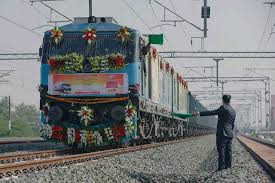
In a major push toward greener, faster, and more efficient transportation of vehicles, Union Railway Minister Ashwini Vaishnaw on Tuesday inaugurated India’s largest automobile in-plant railway siding at Maruti Suzuki’s Manesar facility in Haryana. This significant development is a part of the Haryana Orbital Rail Corridor (HORC) and is expected to transform the way cars are transported across the country.
The new railway siding is not just a logistical milestone—it represents a major leap in India’s transition from truck-based freight movement to railway-driven logistics. Designed to handle up to 4.5 lakh cars annually, the siding is a game changer for both the automobile and railway sectors.
🚘 What Makes the Manesar Siding Unique?
Spanning 46 acres and equipped with 8.2 kilometers of dedicated rail track, the Manesar in-plant railway siding directly links Maruti’s massive manufacturing hub to the Northern Railway’s Patli station, which further connects to the Western Dedicated Freight Corridor (WDFC). This strategic link ensures smoother, faster, and more environment-friendly car transport to various parts of the country.
Previously, Maruti vehicles had to be trucked to far-off railway sidings for loading. With this in-plant setup, the process becomes seamless. Cars now travel from the factory floor straight onto rail wagons without ever touching public roads.
🛤️ A First for North India – Second for Maruti Suzuki
This is the second in-plant siding established by Maruti Suzuki. The first was commissioned earlier this year at its Gujarat (Becharaji) plant. With Manesar now operational, the automaker has demonstrated serious commitment to rail-based logistics, which it says will form 35% of its vehicle transport by FY 2030–31.
“This is a major step toward sustainability and efficiency. The future of logistics lies in railway transport,” Vaishnaw said at the event. He praised the public-private coordination that made this complex project possible under the PM GatiShakti initiative.
🚆 First Rake Flags Off to Nagpur
At the inauguration, the first full rake of 276 vehicles was flagged off from Manesar to Nagpur. This marked not only the operational readiness of the plant’s new logistics system but also a significant step toward reducing road congestion, especially on the busy Delhi–Jaipur Highway (NH-8).
Currently, thousands of trucks ply this corridor, transporting cars from Haryana to different corners of India. By moving a substantial chunk of this load to the railway, Maruti and Indian Railways aim to decongest highways, reduce fuel usage, and cut CO₂ emissions dramatically.
🌱 Eco-Friendly Logistics for a Sustainable Future
The numbers are striking: according to Maruti Suzuki, the new railway siding is expected to help save over 60 million litres of diesel and cut around 175,000 tonnes of carbon emissions annually. That’s the equivalent of planting more than 7 million trees or taking 40,000 cars off the road each year.
By making this strategic shift to railway-based transport, India’s largest carmaker is setting a benchmark for sustainable logistics. It’s a bold step toward the National Green Mobility Plan and supports India’s Net Zero emissions target by 2070.
🏗️ Investment & Infrastructure Under PM GatiShakti
The project, developed under the PM GatiShakti National Master Plan, saw an investment of around ₹452 crore, jointly mobilized by Maruti Suzuki and Indian Railways. It showcases how infrastructure development, when done in partnership with private industry, can generate long-term, system-wide impact.
The Haryana Orbital Rail Corridor (HORC), of which this siding is a part, aims to connect major industrial hubs without passing through Delhi, thereby reducing congestion in the National Capital Region and improving cargo efficiency.
💼 Impact on the Auto Industry
Maruti Suzuki has long relied on traditional road transport, using trailers and trucks to deliver cars to showrooms and depots. But with rising fuel prices, increasing emissions regulations, and traffic bottlenecks, the company had to rethink its strategy.
According to Maruti officials, one train can carry 300 cars, equivalent to around 150 trucks. Trains also reduce delivery time and are more reliable, unaffected by road accidents, traffic jams, or seasonal disruptions like monsoons.
This move could also encourage other automobile manufacturers—like Hyundai, Tata Motors, and Mahindra—to follow suit. If industry-wide rail adoption happens, it could lead to the next big leap in Indian logistics.
🗣️ Public Response and Industry Sentiment
The inauguration has been widely appreciated by industrialists, transport experts, and environmental groups alike. Logistics analysts say this initiative could be a model for other sectors, such as cement, steel, and FMCG, where bulk cargo transport is crucial.
Meanwhile, car buyers can also expect faster delivery timelines in some regions, as rail-based movement reduces lead times by several days.
“This is smart planning. Fewer trucks mean less pollution, lower costs, and quicker turnaround. It’s a win for industry and the environment,” said Anil Sharma, a logistics consultant based in Gurugram.
🇮🇳 A Step Toward a ‘Rail-Reliant’ India
The launch of this siding is symbolic of a larger transformation underway in India’s freight ecosystem. The Indian Railways has long aimed to increase its share in freight movement—from 27% today to 45% by 2030. Projects like the Manesar siding show that the goal is achievable.
With Indian Railways also investing in Amrit Bharat stations, MEMU rakes, and dedicated freight corridors, the future of rail logistics looks promising. As Union Minister Vaishnaw concluded, “This is not just about Maruti or Manesar. This is about reimagining the logistics future of India.”